 Robert Altman has pretty interesting directing style I feel that through much of the films he merely leads you through the plot. He in effect doesn't command you to watch something, he more so suggests things to look at. That's really confusing, but then again so are his movies. Like say in Nashville, he constantly jumps from one character to the other. At first this leaves you wondering if there is something that connects them all, but then because they all seem so disconnected this idea soon vanishes. Not only is his "free flowing camera" really confusing, but so is he use of dialog, or trialog as I'm going to call it because there is never just two people talking, we tend to hear other conversations or people talking on top of the characters shown in the frame. I didn't understand where he was coming from with The Player. He really didn't seem like the murder mystery type from his first two movies, but alas a creative mind can never be truly understood.
Thursday, April 17, 2008
Berto Altman
Robert Altman has pretty interesting directing style I feel that through much of the films he merely leads you through the plot. He in effect doesn't command you to watch something, he more so suggests things to look at. That's really confusing, but then again so are his movies. Like say in Nashville, he constantly jumps from one character to the other. At first this leaves you wondering if there is something that connects them all, but then because they all seem so disconnected this idea soon vanishes. Not only is his "free flowing camera" really confusing, but so is he use of dialog, or trialog as I'm going to call it because there is never just two people talking, we tend to hear other conversations or people talking on top of the characters shown in the frame. I didn't understand where he was coming from with The Player. He really didn't seem like the murder mystery type from his first two movies, but alas a creative mind can never be truly understood.

Thursday, March 27, 2008
Kurosawasan
 Yeah I don't know Japanese, but I feel if I were to talk to Akira Kurosawa right now I'd probably call him that. Akira was a masterful film maker, able to control seemingly every aspect of his craft. I really enjoyed that we got to watch a movie from a plethora of periods of his career. His later films, Yojimbo and Ran really captured my attention, whereas Stray Dog, made me want to quit school and get a GED. I think I enjoyed them because they combined both comedy and action into a sweet samurai flick. One of Kurosawa's more admirable traits is how he was able to tie in the weather in his movies. He didn't shoot them on a back lot of a studio, so he used the weather to his advantage to really put more emotion in the film.
Sunday, March 9, 2008
Danny Isn't Here, Mrs. Torrance
 The Shining (1980) directed by none other than Stanley Kubrick is potentially the most awesomely weird movie I've ever seen. More reminiscent of his 2001: A Space Odyssey or A Clockwork Orange. The Shining is a monumental sci-fi/horror film which takes place almost exclusively in the very empty and very "haunted" Overlook Hotel. Jack Torrance and his family, wife Wendy and son Danny, move into the resort after getting a job as the off-season caretaker.
During the movie everyone noticed how many tracking shots are used. Practically 80% of the film is composed of tracking shots. Kubrick was actually one of the first directors to use a steadicam as it was invented just 4 years before the making of this movie. This movie has had such an impact on the rest of the history of movies, as apparently Spielberg and Scorsese both were hugely influenced by the frequent low tracking shot seen in the flick.
While watching The Shining I kept thinking to myself what the hell, this is so weird. The first hour of the movie we are introduced to psychics and a strangely possessed child, and then it get progressively more out there as time goes on. Spoiler Warning! At the end of the movie Jack goes insane and tries to kill his family, just as the previous care taker Charles Grady. I've been thinking about this for the last like two hours, and I feel there is no logical explanation for what I've just seen. I've come to the conclusion that the hotel is a connection to the past, which people who are untrained with their gift of the shining are able to open up this connection and fuse both the present and past. With Danny there, the past is able to open into the future, and the ghosts of those killed are thus reincarnated into real people. I feel there are too many "loopholes" for anyone explanation to work, which is what intrigues me about this movie.
Friday, February 29, 2008
Hitchcockian
 When I was a little kid, I remember watching The Birds, thinking that this was the scariest movie ever created. For some reason however, whereas Jurassic Park made me not want to watch, The Birds kept me staring at the screen with fear. This unit has really taught me about the amazingness that is Alfred Hitchcock. I really liked the fact that he makes an effort to really include the audience as almost a character in the movie. By using tons of subjective shots, we see what the character does almost making us that character. In Rear Window, all of the parts where they look out upon the courtyard are subjective. So when Lisa goes into Thorwald's apartment, we really feel it right in our gut. His early work, which i feel kind of didn't have this made me not really like them.
Sunday, February 24, 2008
''How do you manage to shoot women and children?'' ''Easy. You don't lead them so far.''
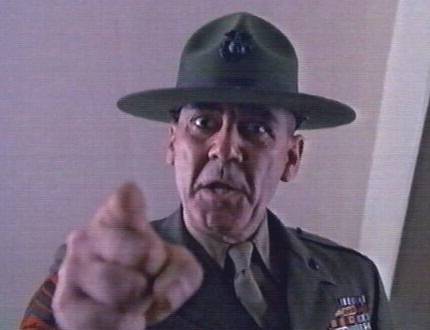
Full Metal Jacket (1987) is in my opinion one of Stanley Kubrick's greatest works. (Granted I've only seen like four of them, so take that with a grain of salt.) As in many of his other flicks, Kubrick is seen as very critical of man's choice to partake in wars. The movie is split up into two distinct parts: a Training Camp and Vietnam. At the training camp we meet Sergeant Hartman, who's job is to produce killing machines. He often bullies a dimwitted and overweight man by the name of Leonard Lawrence, whom he nick name's Gomer Pyle. After getting all of the recruits in trouble. Long story short, all the bullying makes Leonard go crazy and kill the Serge. The latter half of the film follows a character introduced in the first half as he makes his way through Vietnam during the Tet Offensive. The movie shows how the army uses dehumanizing tactics to make murderers.
Thursday, February 14, 2008
Paths of Glory
 Paths of Glory, one of Stanley Kubrick's earlier films depicts a battle during WWI in the French trenches. This film is widely regarded as one of his better films. Now I may be going out on a limb, but in the first 15 minutes of this film a feeling of immense satire over took my body. Probably because the film opens with a huge palace occupied by one of the commanding generals. The French troops are ordered by their superiors to attack the Ant Hill, a station which the German's have been able to hold for the past year. One of the main incentives of this attack is for General Mireau to get another star. He is willing to kill 65% of the troops to do this. Kubrick clearly was influenced by the cannon-fodder theory of war. Where military personnel are treated as expendable in the face of fire, as seen in the scene where he orders an attack on his on troops who haven't yet ran into the death zone.
I feel he shows the corruptness that power and ranking bring to a person. In the first recon mission. A drunken Lieutenant Paris, becomes confused and kills one of his own men. He then says to Roget, "Have you ever tried to bring charges against an office? It's my word against yours, you know, and whose word do you think they're gonna believe- or, let me put it another way, whose word do you think they're going to accept?" This quote shows the totalitarian form of power held by high ranking officials, with no check or balances they are free to be huge asses.
One of my favorite parts of the film was the final scene, after a bunch of innocent men were sent to a firing squad because they were too weak. Dax played by Kirk, comes in on a conversation between Mireau and Broulard , another high ranking official where Mireau is informed there will be an inquiry on his actions during the attack on the ant hill.
I hope this works, but this is the firing squad scene, it really captures Kubrick's directing style, where the soldiers are shown at high angle signifying their unimportance, and the Colonels are show at a low angle showing power.
Wednesday, December 19, 2007
To Do Or Not To Do The Right Thing?
"Do the Right Thing" chronicles race relations between a black population and three intruding white business owners in Bed-Stuy New York, which I feel masterfully portrays how stupid racism is. The film starts off very relaxed, but as the heat burns on racism and hatred start popping up everywhere. One scene which I feel shows the stupidity of racism is when a character of each race starts shouting racist slang directly at the camera. It shows how all of these people are racist against each other, which basically them all the same, hence there should be no racism.
The Film Climax's with a violent riot, where people are killed and shops are burned. Mookie arguably the main character starts the riot by throwing a garbage can through the window of Sal's restaurant. It gets ransacked and burned. Mookie didn't do the right thing, there are better ways to get over the grief of loosing a loved one, that destruction. P.S. I loved the intro Rosie Perez is a bomb dancer.
The Film Climax's with a violent riot, where people are killed and shops are burned. Mookie arguably the main character starts the riot by throwing a garbage can through the window of Sal's restaurant. It gets ransacked and burned. Mookie didn't do the right thing, there are better ways to get over the grief of loosing a loved one, that destruction. P.S. I loved the intro Rosie Perez is a bomb dancer.
Subscribe to:
Posts (Atom)